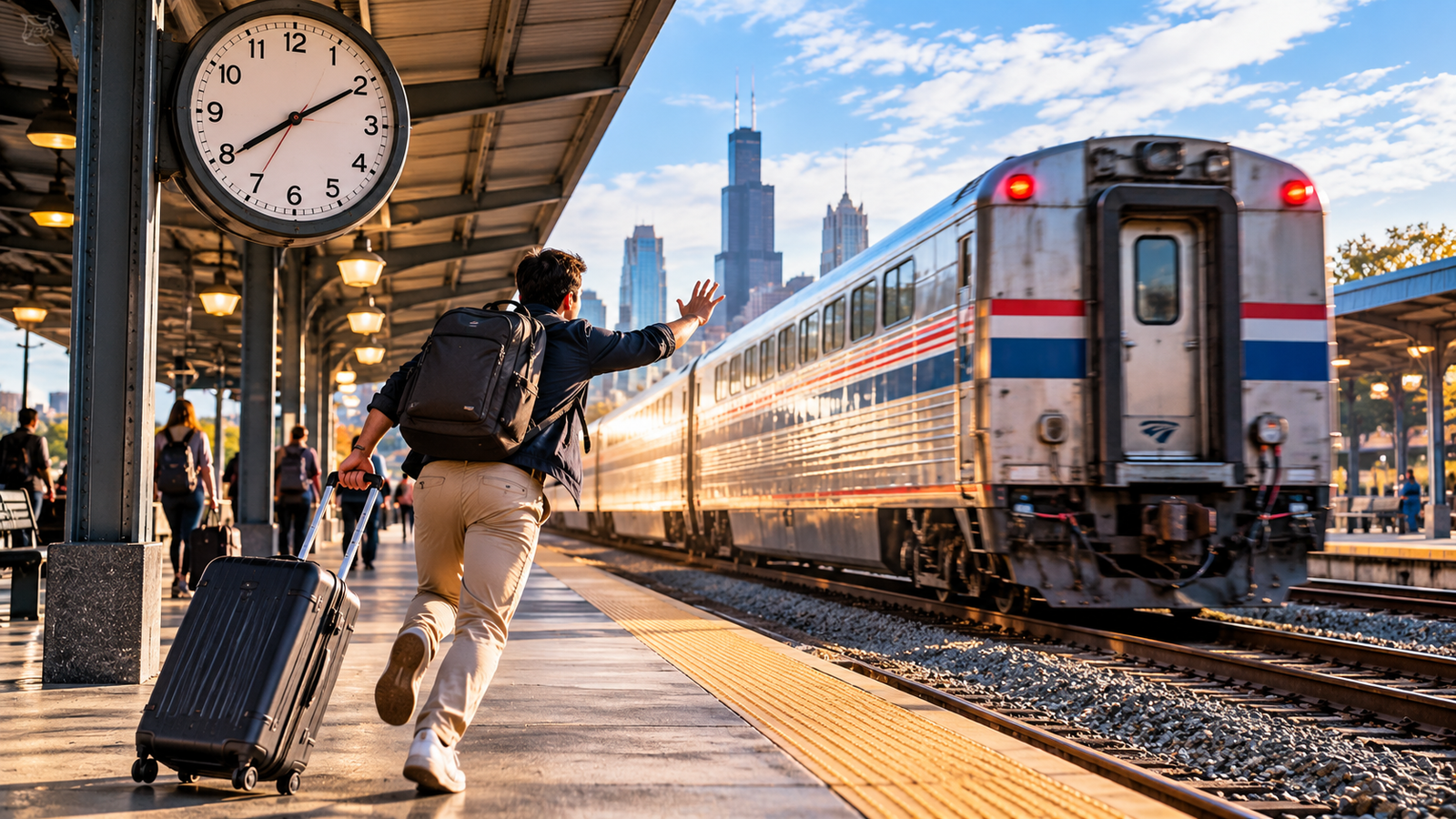
Train Travel vs Flying: Which Is Better in the USA?
Choosing between a train and a plane can significantly affect your overall travel experience. When comparing train travel vs flying, the better option depends on your route, budget, available time, luggage needs, comfort preferences, and where your journey begins and ends.
Flying is often associated with faster long-distance travel, while trains can provide a more relaxed journey with convenient city-center connections on many routes. However, comparing only the scheduled travel time does not always tell the complete story.
Airport security, travel to and from the airport, baggage procedures, boarding time, and potential connections can add time to a flight journey. Train travel has its own considerations, including longer journey times on many routes and limited rail service in some parts of the country.
This guide compares train travel and flying in the USA to help you decide which option may work better for your next trip.

Train Travel vs Flying: What Is the Main Difference?
The biggest difference is how each mode of transportation fits into your overall journey.
Flights are designed to cover large distances relatively quickly.
For cross-country trips or journeys between distant regions, flying can save considerable travel time.
Train travel usually takes longer over large distances but can provide a different type of experience.
Rail passengers can often move around during the journey, enjoy changing scenery, and avoid some of the procedures associated with airports.
The better choice depends on more than speed.
You should compare the entire journey from your starting point to your final destination.
Train vs Plane Travel Time
Travel time is one of the most important factors when choosing between a train and a plane.
A flight between two cities may have a much shorter scheduled duration than a train journey covering the same general route.
However, flight time is only one part of air travel.
Your complete flying experience may include:
✓ Traveling to the airport
✓ Arriving before departure
✓ Security screening
✓ Boarding
✓ Flight time
✓ Deplaning
✓ Baggage collection
✓ Transportation from the airport
Train travel also requires preparation before departure, but many rail stations are located in or near city centers.
On shorter regional routes, this can make the total travel-time comparison more competitive than simply comparing the flight duration with the train schedule.
For long-distance or cross-country travel, flying will usually have a significant advantage in speed.
Train vs Plane Cost
There is no universal answer to whether trains or planes are cheaper.
Ticket prices can vary depending on:
✓ Route
✓ Travel date
✓ Demand
✓ Booking time
✓ Fare type
✓ Seat or accommodation
✓ Baggage
✓ Optional services
A low airfare may initially appear cheaper than a train ticket, but the total cost can change after adding baggage, seat selection, airport transportation, or other expenses.
Train fares can also vary significantly.
Premium seating and private sleeping accommodations can cost considerably more than standard Coach travel.
The best approach is to compare the complete cost of both journeys instead of assuming one option will always be cheaper.
If budget is your priority, learn how to find cheap train tickets before comparing the total cost of rail and air travel.
Is Train Travel More Comfortable Than Flying?
Comfort is subjective, but it is one area where many travelers consider rail travel appealing.
Train passengers can generally get up and move around during appropriate parts of the journey.
Depending on the train and ticket type, the experience may include spacious seating, access to food service, Wi-Fi, electrical outlets, or other amenities.
Airplanes are designed to transport large numbers of passengers efficiently, and available space depends significantly on the airline, aircraft, cabin, and seat selected.
A short flight may be perfectly comfortable for many travelers.
For longer journeys, your preference may depend on whether you value reaching your destination quickly or spending more time traveling with additional opportunities to move around.
Luggage: Train vs Plane
Luggage can influence the decision between train travel vs flying.
Airline baggage policies vary by carrier and fare type. Depending on your ticket, checked baggage, carry-on luggage, or seat selection may involve additional charges.
Rail operators have their own baggage rules, including size, weight, quantity, and route-specific restrictions.
Checked baggage may not be available on every train or at every station.
Before choosing between rail and air travel, consider how much luggage you plan to bring.
Do not compare only the base ticket price if baggage will be an important part of your trip.
Train Stations vs Airports
Location can have a major effect on convenience.
Airports
Many airports are outside central downtown areas, which means travelers may need a taxi, rideshare, rental car, shuttle, or public transportation to reach their final destination.
Rail Stations
Many major rail stations are located closer to city centers.
This can be particularly useful for travelers visiting downtown hotels, offices, attractions, or event venues.
However, this advantage depends entirely on the cities involved.
Sometimes an airport may be more convenient for your destination than the rail station.
Compare the actual locations before booking.
Security and Boarding Experience
Flying and train travel have different boarding experiences.
Air travel generally involves airport security procedures before reaching the gate.
Passengers are also encouraged or required to arrive sufficiently early for check-in, baggage, security, and boarding.
Train travel can involve a different station experience.
The exact boarding process depends on the station, route, operator, and type of service.
Large train stations can still be busy, particularly during holidays and peak travel periods.
Regardless of how you travel, arriving with enough time to locate the correct departure area can help reduce unnecessary stress.
Which Is Better for Short-Distance Travel?
For certain short and medium-distance city pairs, train travel can be highly practical.
This is particularly true when both cities have centrally located stations and direct rail service.
If the train takes you from downtown to downtown, you may avoid lengthy trips to and from airports.
However, flying may still be faster on some routes.
The best comparison should include door-to-door travel time rather than only the scheduled train or flight duration.
Consider where you are starting, where you are going, and how much additional transportation each option requires.
Which Is Better for Long-Distance Travel?
For travelers who need to cover a very large distance quickly, flying generally has a major time advantage.
A journey that takes several hours by plane can take much longer by train.
However, not every traveler chooses rail based purely on speed.
Some passengers specifically want to experience long-distance train travel.
They may enjoy watching the scenery, relaxing during the journey, visiting multiple destinations, or making the transportation itself part of the vacation.
If your priority is reaching a distant destination as quickly as practical, flying may be more suitable.
If the journey is part of the experience, rail travel may be worth considering.
If rail travel suits your itinerary, our complete guide to booking train tickets online can help you understand the booking process before planning a longer journey.
Train Travel vs Flying for Business Trips
Business travelers often prioritize time, reliability, location, and the ability to work while traveling.
Flying may be the practical choice when meetings are taking place far from the departure city.
On shorter corridors, rail travel may be convenient if stations are close to business districts.
Train travel can also provide time for reading, writing, reviewing documents, or completing other tasks.
Internet availability can vary, so travelers should download important files before departure rather than relying entirely on onboard connectivity.
The best option for business travel depends on the route and meeting schedule.
Train vs Plane for Family Travel
Families have different priorities than solo travelers.
Parents may consider:
✓ Ticket costs
✓ Luggage
✓ Travel time
✓ Seating
✓ Food
✓ Entertainment
✓ Station or airport transfers
✓ Ease of moving around
A shorter flight can reduce total travel time, which may be useful with young children.
On the other hand, some families may appreciate being able to move around more easily during a train journey.
The right choice depends on the age of the children, route length, budget, and family travel preferences.
Which Is Better for Scenic Travel?
If scenery is an important part of your journey, train travel has a clear appeal.
Rail routes can pass through landscapes that travelers might otherwise never see from a highway or airport.
Depending on the route, passengers may travel through mountains, rivers, forests, deserts, coastlines, small towns, and rural landscapes.
Flying provides its own impressive views, particularly during takeoff, landing, and clear weather.
However, the experience is different.
For travelers who want transportation to become part of the vacation itself, scenic rail travel can be an attractive option.
Train Travel vs Flying for Overnight Trips
An overnight journey creates another important comparison.
A late flight may allow you to reach your destination quickly, but you still need to consider airport transportation and arrival time.
An overnight train can allow the journey to continue while you rest, depending on the route and accommodation selected.
Some long-distance trains offer private sleeping accommodations in addition to Coach seating.
Sleeping accommodations can increase the total ticket cost, so compare them with the combined cost of a flight and hotel when appropriate.
For some travelers, the overnight train experience is part of the attraction.
For others, a faster flight and a hotel room may be more comfortable.
Train vs Plane for Last-Minute Travel
Last-minute prices can vary significantly for both trains and flights.
Demand, available inventory, route popularity, and travel dates can affect the fare you see.
Do not assume that one transportation method will automatically offer a better last-minute deal.
Search both options if your travel date is approaching.
Also consider the schedule.
A cheaper ticket may not provide good value if it requires an inconvenient departure time or adds several hours to your journey.
Planning ahead can give you more options, so it helps to understand how early you should book train tickets before your preferred travel date.
Is Train Travel Less Stressful Than Flying?
Some travelers find train travel less stressful because they prefer the station and boarding experience.
Others prefer flying because spending less time in transit is more important to them.
Stress can depend on several personal factors.
Someone who dislikes airports may prefer a train even if the journey is longer.
Someone who dislikes sitting in transit for many hours may prefer a flight.
Instead of asking which option is universally less stressful, consider which parts of travel you personally find inconvenient.
Advantages of Train Travel
Train travel can offer several potential benefits.
City-center stations may make some journeys convenient.
Passengers can often move around during longer trips, and scenic routes can turn transportation into part of the travel experience.
Rail can also be useful for multi-city itineraries where destinations are connected by convenient train service.
Travelers who are not in a hurry may appreciate the slower pace and opportunity to see more of the country.
However, these advantages vary by route.
Always check the actual train service available for your destination.
Advantages of Flying
The primary advantage of flying is speed over long distances.
Air travel connects cities across the United States that could require a full day or significantly longer to reach by train.
Flights also provide access to many destinations where passenger rail options may be limited or unavailable.
For travelers with limited vacation time, saving many hours in transit can be more important than having a scenic journey.
Flying can also provide numerous schedule choices on busy routes, depending on the airports and airlines serving them.
Travelers considering air travel can also explore available flight options and compare schedules before deciding between a train and a plane.
How to Choose Between Train and Plane
Start by comparing door-to-door travel time.
Then compare the complete price, including any baggage fees, seat charges, airport or station transportation, and overnight accommodation that may be required.
Next, consider convenience.
Ask yourself whether the airport or train station is closer to your actual destination.
Think about luggage, comfort, flexibility, and how much time you have available.
For a short city-to-city trip, the train may be highly competitive.
For a cross-country journey with limited time, flying may be much more practical.
For a vacation where the journey itself matters, rail travel may provide the experience you want.
Final Thoughts
When comparing train travel vs flying, there is no single option that is better for every journey.
Flying is usually the faster choice for long-distance travel and can be especially useful when your available travel time is limited.
Train travel can offer a comfortable alternative on certain routes, particularly when stations are conveniently located and you want the journey to become part of your travel experience.
Do not compare only ticket prices or scheduled travel times.
Look at the complete journey, including transportation to the station or airport, baggage, boarding time, comfort, additional fees, and arrival location.
By comparing these factors together, you can choose the transportation option that provides the best combination of time, cost, convenience, and experience for your trip.
When rail travel is the better fit for your journey, you can explore train tickets online and review options for your next trip.
Frequently Asked Questions
Is train travel better than flying?
It depends on your route and priorities. Train travel can be convenient and enjoyable for certain city pairs, while flying generally saves more time on long-distance journeys.
Is it cheaper to travel by train or plane?
Neither option is always cheaper. Prices vary according to route, date, demand, fare type, baggage, seating, and other costs.
Is traveling by train more comfortable than flying?
Some travelers prefer trains because they can move around more easily and may have more space depending on the service. Comfort varies by train, aircraft, seat, and ticket type.
Is a train better than a plane for short trips?
It can be, particularly when rail stations are centrally located and the route offers convenient direct service. Compare total door-to-door travel time.
Is flying better for long-distance travel?
Flying usually has a significant time advantage for long-distance journeys, especially when crossing large regions of the United States.
Are train stations more convenient than airports?
Many major train stations are located near city centers, but this varies by destination. Compare the actual airport and station locations for your trip.
Is train travel good for business trips?
Yes, particularly on routes connecting major city centers. However, flying may be more practical when the destination is far away or time is limited.
Is train travel good for families?
It can be. Families may appreciate the ability to move around during longer journeys, while a shorter flight may be preferable when minimizing travel time is the priority.
Is train travel better for scenic trips?
Train travel can be an excellent choice when scenery is part of the experience, as many routes pass through landscapes that can be enjoyed throughout the journey.
How do I decide between a train and a plane?
Compare total travel time, complete trip cost, station and airport locations, baggage, comfort, schedule, and your personal travel priorities before booking.